

In 2026, the semiconductor materials industry is at a historical turning point. Silicon, the backbone of the semiconductor industry, is approaching its physical limits, while next-generation wide-bandgap materials such as silicon carbide (SiC) and gallium nitride (GaN) are rapidly emerging, driving high-performance advancements in power electronics, RF communication, optoelectronics, and electric vehicles. This article systematically analyzes the five major semiconductor material trends in 2026, examining the technical, industrial, and market logic, and exploring potential future developments.
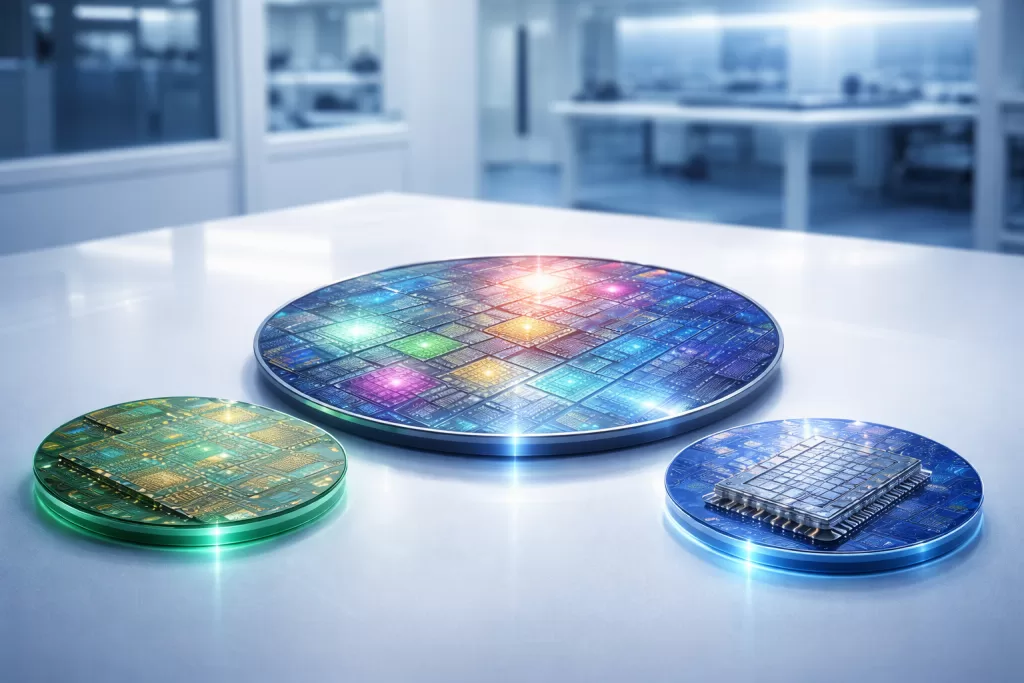
1. Silicon Remains Dominant, but High-Performance and Heterogeneous Integration Are Key
Silicon continues to be the mainstay of the semiconductor industry, accounting for approximately 85% of global wafer shipments. Despite physical limitations, technological innovation is rejuvenating silicon. Key trends in 2026 include:
- Ultra-Low Resistivity (ULR) Silicon Wafers
Through precise doping and high-purity crystal growth, silicon wafer resistivity has decreased to ≤0.001 Ω·cm, significantly reducing power loss. In high-performance computing (HPC) and data center server power modules, efficiency gains of 10%-15% are achievable. - Silicon Photonics Advances
Silicon photonics devices are maturing, enabling optical communication to be integrated directly onto silicon chips. This reduces interconnect latency and power consumption, supporting AI chips, cloud computing, and 6G base stations. - Heterogeneous Integration
Integration of different functional materials, such as III-V compounds, onto silicon chips allows high-speed communication, low-power optoelectronic conversion, and high-temperature operation. Silicon is evolving from a “single material” to a “platform material” supporting multiple functionalities.
Analysis: Silicon’s role is shifting from “core material” to “multi-material integration platform,” with high-performance innovation extending its relevance.
2. Silicon Carbide (SiC) Accelerates Industrialization as the Standard for High-Power Applications
SiC’s wide bandgap (3.26 eV), high thermal conductivity (~490 W/m·K), and high breakdown voltage make it ideal for high-power, high-temperature, and high-frequency applications. Key 2026 trends include:
- Wafer Size Expansion
Industrial SiC wafers are growing from 6-inch to 8-inch and even 12-inch, reducing unit cost and improving yield. This supports large-scale EV power modules reliably. - Device Integration and Modularization
SiC MOSFETs and diodes can be integrated onto a single chip, reducing PCB layout complexity, lowering power loss, and simplifying thermal management. - Expanded Application Fields
Beyond EVs, PV inverters, and industrial drives, SiC is increasingly used in aerospace, high-temperature industrial sensors, and other extreme environments. - Green Manufacturing and Material Recycling
Recycling of SiC scraps and edge wafers is becoming routine, and process optimization reduces energy consumption, promoting sustainable production of high-end power devices.
Observation: SiC is not just a material choice—it is a core driver of efficiency revolution in EVs and renewable energy equipment.
3. Gallium Nitride (GaN) Leads in High-Frequency, High-Efficiency, and Miniaturized Applications
GaN, with its high electron mobility and wide bandgap (3.4 eV), is becoming mainstream in RF and high-power switching applications. Major 2026 trends include:
- High-Voltage GaN HEMTs
Industrial GaN HEMTs in the 650V–1200V range are replacing silicon devices, improving efficiency by 20%-30% in DC-DC converters and onboard EV chargers (OBC). - Millimeter-Wave and 6G RF Applications
GaN high-frequency devices support 28 GHz, 39 GHz, and 60 GHz bands, making them essential for 6G base station RF power amplifiers, ensuring high data rates and low latency. - GaN-on-Si and Cost Optimization
Growing GaN on silicon substrates (GaN-on-Si) enables large-area wafer production, reducing manufacturing costs and accelerating adoption in consumer fast chargers, server power supplies, and EVs. - Miniaturization and System-Level Integration
GaN’s small size and high frequency allow power modules to be lighter and more compact, meeting requirements for portable electronics, drones, and electric vehicles.
Observation: GaN’s development is not only a material performance breakthrough but also critical for reducing power supply size and improving efficiency.
4. Composite and Heterogeneous Integration: Breaking Performance Limits
Single materials are reaching physical limits, and composite and heterogeneous integration is the new trend:
- SiC + GaN Hybrid Integration
High-voltage modules use SiC, while high-frequency control circuits use GaN, achieving optimal material combinations that reduce heat loss and shrink module size. - 2D Materials Integration (Graphene, h-BN, etc.)
Graphene for thermal management and hexagonal boron nitride for insulation and thermal stability enhance power density and device reliability. - 3D Integration Technology
Wafer-level stacking and Through-Silicon Via (TSV) interconnects allow ultra-high functional density in compact volumes, ideal for HPC and AI accelerator cards.
Insight: Material composites and heterogeneous integration are key to surpassing the performance limits of single materials, and they represent the mainstream direction for future chip design.
5. Sustainable Manufacturing and Environmental Compliance as Industry Mandates
Driven by global carbon neutrality goals and environmental regulations, semiconductor manufacturing is transforming:
- Low-Carbon Wafer Processes
Optimization of epitaxial growth, polishing, and etching reduces wafer production carbon emissions by 20%-30%. - Waste Recycling and Reuse
Recycling of edge scraps, defective wafers, and chemical reagents reduces material waste and improves cost efficiency. - Eco-Friendly Packaging Materials
High-performance, environmentally friendly epoxies and lead-free solder ensure both device reliability and regulatory compliance. - Life-Cycle Assessment (LCA)
Full consideration of environmental impact from material selection, manufacturing, usage, to recycling enables a sustainable semiconductor supply chain.
Conclusion: In 2026, semiconductor innovation is not only about technical breakthroughs but also about strategic upgrades driven by environmental responsibility.
Summary and Outlook
In 2026, semiconductor material development follows five parallel paths:
- High-performance silicon and heterogeneous integration;
- Large-scale industrialization and modular applications of SiC;
- GaN high-frequency, high-efficiency device commercialization;
- Composite and heterogeneous integration for performance limits;
- Sustainable manufacturing and eco-friendly materials as mandatory standards.
Core Logic: Performance breakthrough + material innovation + sustainable manufacturing = the new ecosystem of semiconductor materials.
In the next decade, those who achieve the optimal balance between material performance, system integration, and green manufacturing will control the core competitiveness of next-generation semiconductors.
Tags:TOP 1 Exceeding Sapphire crystal watch case waterproof, scratch-resistant, pressure-resistant 6-Inch Sapphire Wafer: Price, Providers, and Manufacturer Direct Trends 2025